11月10日美股盘中, 伯克希尔-哈撒韦公司官网发布了 沃伦·巴菲特的最新捐赠决定以及他的致股东信.
巴菲特以”股神”之名为大家所熟知, 一生都致力于投资事业. 当然, 也用自己的赫赫战绩为自己”股神”之名正名. 下面是一张网上找到的巴菲特投资生涯的收益图:
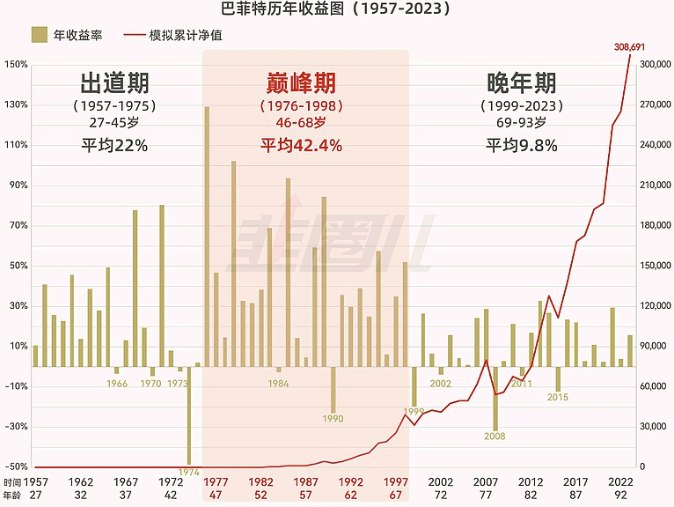
45岁之前, 年化收益是 22%, 46-68岁是 42.4%, 晚年是 9.8%
对于他的资金体量来说, 这个收益是相当离谱的. 对于我自己这个股市小白来说, 也是我辈这一生追求的极致目标了. 正如他股东信中所说:
选择你的榜样,努力像他们一样.
以下为致股东信原文:
致我的股东朋友们:
从今年起,我将不再撰写伯克希尔的年度报告,也不会再在年度股东大会上长篇大论。正如英国人所说,我要“安静辞职”(go quiet)了。
——嗯,算是吧。
格雷格·阿贝尔(Greg Abel)将在年底接任CEO职位。他是一位出色的管理者、不知疲倦的工作者,也是一个诚实的沟通者。祝他任期长久。
我会继续通过每年的“感恩节信”与大家以及我的孩子们谈谈伯克希尔。伯克希尔的个人股东是一群特别的人,他们乐于与不幸者分享自己的财富。我珍惜这种联系。请允许我今年稍作回顾,然后谈谈我打算如何分配我的伯克希尔股票,最后说几句关于事业和人生的感想。
回顾与感恩
感恩节临近,我对自己能在95岁时仍健在感到既惊讶又感激。年轻时,我可没料到能活这么久。1938年,我差点去世。
那时的奥马哈,医院被分为“天主教医院”和“新教医院”。我们的家庭医生哈利·霍茨(Harley Hotz)是一位友善的天主教徒,会提着黑包上门出诊。他叫我“小船长”,收费也不高。
有一天我肚子剧痛,霍茨医生来看了,说我第二天早上就会好。后来他吃了晚饭、打了几圈桥牌,却始终对我的症状放心不下。深夜,他让我去圣凯瑟琳医院做急诊阑尾手术。接下来三周,我仿佛身处修道院,还挺享受这种“讲台”生活。护士修女们都喜欢我,我更是爱说话(那时就这样)。
我的三年级老师麦德森(Madsen)让全班三十名同学每人写信给我。我可能把男生的信扔了,但女生写的我反复看。住院也有收获。
最难忘的是,我的姨妈Edie送了我一套专业指纹套装。我马上给所有照顾我的修女按了指纹。我那时的“理论”——当然很荒唐——是总有一天会有一个修女犯罪,而FBI发现他们竟没采修女指纹。那时J·埃德加·胡佛(J. Edgar Hoover,FBI创始人)是国民偶像,我幻想他会来奥马哈亲自查看我的收藏。
结果当然没有。但讽刺的是,后来事实证明,我倒该去采胡佛的指纹——他后来因滥用职权而身败名裂。
那就是1930年代的奥马哈。那时孩子们最渴望的礼物是一辆雪橇、一辆自行车、一只棒球手套或一列电动火车。
奥马哈的人与缘分
我得从查理·芒格说起,陪伴我64年的挚友。1930年代,查理住在离我现在的家仅一条街的地方。
1940年,他在我祖父的杂货店打工,10小时赚2美元(节俭在巴菲特家族是基因)。第二年我也在那干活,但我们直到1959年才第一次见面。
查理从哈佛法学院毕业后定居加州,但他一直说奥马哈塑造了他的人生。六十多年来,他是我最好的老师和“兄长”。我们意见有分歧,但从不吵架。
1958年,我买了人生第一栋也是唯一一栋房子,至今仍住在那。离我童年住所两英里,离岳父母家两个街区,离我上班的办公室车程七分钟。
另一位奥马哈人是斯坦·利普西(Stan Lipsey)。他1968年把《奥马哈太阳报》卖给伯克希尔,后来我派他去布法罗拯救那里的《晚报》。他让这份原本亏损的报纸年回报超过100%。
斯坦家离我家五个街区,而他的邻居是沃尔特·斯科特(Walter Scott)——他后来把中美能源卖给伯克希尔,还当了多年董事。沃尔特是内布拉斯加州的慈善领袖,他的影响遍布整个州。
还有唐·基欧(Don Keough),1959年就住在我家对面100码处。那时他是咖啡推销员,后来成了可口可乐总裁和伯克希尔董事。1985年他因推出“新可乐”惨败,勇敢地在公开演讲中道歉并恢复原味可乐——销量随后暴涨。他的那场演讲至今仍是经典。
我与唐、查理一样,都来自中西部,热情、坦率、真正的美国人。
后来还有阿吉特·贾因(Ajit Jain)和格雷格·阿贝尔,他们都曾在上世纪末住在奥马哈几个街区内。看来奥马哈的水确实有点魔力。
回到奥马哈
我青少年时在华盛顿住过几年,1954年去了纽约,以为会在那里终老。那时我受本·格雷厄姆照顾,结识了许多朋友。但一年半后,我又回到了奥马哈,再也没离开。
我的三个孩子都在这里长大、上公立学校。我的父亲、第一任妻子苏茜、查理、斯坦·利普西、布鲁姆金家族(他们经营内布拉斯加家具商场)和杰克·林瓦尔特(把National Indemnity卖给伯克希尔)都毕业于同一所高中。
幸运与生命
我在奥马哈受益良多。这里塑造了我和伯克希尔,也塑造了我们的运气。美国的中心,是个创业、生活和养家的绝佳地方。
我家族的最长寿纪录原是92岁,我打破了它。多亏了优秀的奥马哈医生,他们几次救了我的命。
但老年需要好运——要每天躲开香蕉皮、车祸、雷击等种种意外。幸运女神极不公平,往往偏爱已经幸运的人。
我1930年出生在美国,健康、聪明、白人、男性——谢谢你,幸运女神。我的姐妹一样聪明却不享有同样机会。
面对衰老与未来
“时间之父”不会放过任何人。迟早他会赢。虽然我行动变慢、视力减退,但我仍每天去办公室工作。
不过,我的长寿也让遗产分配必须提速。我的三个孩子已分别72、70和67岁。我希望在他们仍健康、头脑清晰时,让他们主导我几乎全部的慈善遗产。
我会保留部分A类股,直到股东们对格雷格像信任查理和我一样放心。那不会太久。
我的孩子们有智慧、有经验、有判断力,也有同情心。他们会活得比我久,可以更灵活地应对税务或慈善政策变化。我从不想“死后掌权”。
关于伯克希尔与格雷格
我加快慈善捐赠,并不代表我对伯克希尔前景信心减弱。格雷格·阿贝尔完全符合我当年的预期。他理解我们的业务和员工,学习能力极强。
我认为世界上不会有任何CEO比他更适合管理我们的公司和股东资金。希望他健康长寿。
伯克希尔未来会更大、更稳健,但偶尔股价会跌50%。别惊慌,美国会反弹,伯克希尔也会。
最后的忠告
我比前半生更满意后半生。别为过去的错误自责——学一点教训,继续前进。选对榜样,模仿他们。
记住阿尔弗雷德·诺贝尔的故事:他误读了自己的讣告,吓得改变了人生。你不用等那种意外——现在就决定希望别人如何记住你。
伟大不是金钱、名气或权力,而是善行。善良无价。
清洁工和董事长一样,都是人。
祝你们感恩节快乐——是的,连那些“讨厌鬼”也一样;改正永远不晚。感谢美国给予的机会,即便回报分配并不总是公平。
选择你的榜样,努力像他们一样。你永远不会完美,但可以一直变得更好。
最后附上 英文原文链接:
以及英文原文摘录:
BERKSHIRE HATHAWAY INC.
NEWS RELEASE
FOR IMMEDIATE RELEASE November 10, 2025
Omaha, NE (BRK.A; BRK.B) –
Today, Warren E. Buffett converted 1,800 A shares into 2,700,000 B shares in order to give these B shares to four family foundations: 1,500,000 shares to The Susan Thompson Buffett Foundation and 400,000 shares to each of The Sherwood Foundation, The Howard G. Buffett Foundation and NoVo Foundation. These donations have been delivered today.
Mr. Buffett’s comments to his fellow shareholders follow:
To My Fellow Shareholders:
I will no longer be writing Berkshire’s annual report or talking endlessly at the annual meeting. As the British would say, I’m “going quiet.”
Sort of.
Greg Abel will become the boss at yearend. He is a great manager, a tireless worker and an honest communicator. Wish him an extended tenure.
I will continue talking to you and my children about Berkshire via my annual Thanksgiving message. Berkshire’s individual shareholders are a very special group who are unusually generous in sharing their gains with others less fortunate. I enjoy the chance to keep in touch with you. Indulge me this year as I first reminisce a bit. After that, I will discuss the plans for distribution of my Berkshire shares. Finally, I will offer a few business and personal observations.
As Thanksgiving approaches, I’m grateful and surprised by my luck in being alive at 95. When I was young, this outcome did not look like a good bet. Early on, I nearly died.
It was 1938 and Omaha hospitals were then thought of by its citizens as either Catholic or Protestant, a classification that seemed natural at the time.
Our family doctor, Harley Hotz, was a friendly Catholic who made house calls toting a black bag. Dr. Hotz called me Skipper and never charged much for his visits. When I experienced a bad bellyache in 1938, Dr. Hotz came by and, after probing a bit, told me I would be OK in the morning.
He then went home, had dinner and played a little bridge. Dr. Hotz couldn’t, however, get my somewhat peculiar symptoms out of his mind and later that night he dispatched me to St. Catherine’s Hospital for an emergency appendectomy. During the next three weeks, I felt like I was in a nunnery, and began enjoying my new “podium.” I liked to talk – yes, even then – and the nuns embraced me.
To top things off, Miss Madsen, my third-grade teacher, told my 30 classmates to each write me a letter. I probably threw away the letters from the boys but read and reread those from the girls; hospitalization had its rewards.
The highlight of my recovery – which actually was dicey for much of the first week – was a gift from my wonderful Aunt Edie. She brought me a very professional-looking fingerprinting set, and I promptly fingerprinted all of my attending nuns. (I was probably the first Protestant kid they had seen at St. Catherine’s and they didn’t know what to expect.)
My theory – totally nutty, of course – was that someday a nun would go bad and the FBI would find that they had neglected to fingerprint nuns. The FBI and its director, J. Edgar Hoover, had become revered by Americans in the 1930s, and I envisioned Mr. Hoover, himself, coming to Omaha to inspect my invaluable collection. I further fantasized that J. Edgar and I would quickly identify and apprehend the wayward nun. National fame seemed certain.
Obviously, my fantasy never materialized. But, ironically, some years later it became clear that I should have fingerprinted J. Edgar himself as he became disgraced for misusing his post.
Well, that was Omaha in the 1930s, when a sled, a bicycle, a baseball glove and an electric train were coveted by me and my friends. Let’s look at a few other kids from that era, who grew up very nearby and greatly influenced my life but of whom I was for long unaware.
I’ll begin with Charlie Munger, my best pal for 64 years. In the 1930s, Charlie lived a block away from the house I have owned and occupied since 1958.
Early on, I missed befriending Charlie by a whisker. Charlie, 6 ⅔ years older than I, worked in the summer of 1940 at my grandfather’s grocery store, earning $2 for a 10-hour day. (Thrift runs deep in Buffett blood.) The following year I did similar work at the store, but I never met Charlie until 1959 when he was 35 and I was 28.
After serving in World War II, Charlie graduated from Harvard Law and then moved permanently to California. Charlie, however, forever talked of his early years in Omaha as formative. For more than 60 years, Charlie had a huge impact on me and could not have been a better teacher and protective “big brother.” We had differences but never had an argument. “I told you so” was not in his vocabulary.
In 1958, I bought my first and only home. Of course, it was in Omaha, located about two miles from where I grew up (loosely defined), less than two blocks from my in-laws, about six blocks from the Buffett grocery store and a 6-7-minute drive from the office building where I have worked for 64 years.
Let’s move on to another Omahan, Stan Lipsey. Stan sold the Omaha Sun Newspapers (weeklies) to Berkshire in 1968 and a decade later moved to Buffalo at my request. The Buffalo Evening News, owned by a Berkshire affiliate, was then locked in a battle to the death with its morning competitor who published Buffalo’s only Sunday paper. And we were losing.
Stan eventually built our new Sunday product, and for some years our paper – formerly hemorrhaging cash – earned over 100% annually (pre-tax) on our $33 million investment. This was important money to Berkshire in the early 1980s.
Stan grew up about five blocks from my home. One of Stan’s neighbors was Walter Scott, Jr.Walter, you will remember, brought MidAmerican Energy to Berkshire in 1999. He was also a valued Berkshire director until his death in 2021 and a very close friend. Walter was Nebraska’s philanthropic leader for decades and both Omaha and the state carries his imprint.
Walter attended Benson High School, which I was scheduled to attend as well – until my dad surprised everyone in 1942 by beating a four-term incumbent in a Congressional race. Life is full of surprises.
Wait, there’s more.
In 1959, Don Keough and his young family lived in a home located directly across the street from my house and about 100 yards away from where the Munger family had lived. Don was then a coffee salesman but was destined to become president of Coca-Cola as well as a devoted director of Berkshire.When I met Don, he was earning $12,000 a year while he and his wife Mickie were raising five children, all destined for Catholic schools (with tuition requirements).
Our families became fast friends. Don came from a farm in northwest Iowa and graduated from Omaha’s Creighton University. Early on, he married Mickie, an Omaha girl. After joining Coke, Don went on to become legendary around the globe.
In 1985, when Don was president of Coke, the company launched its ill-fated New Coke. Don made a famous speech in which he apologized to the public and reinstated “Old” Coke. This change of heart took place after Don explained that Coke incoming mail addressed to “Supreme Idiot” was promptly delivered to his desk. His “withdrawal” speech is a classic and can be viewed on YouTube. He cheerfully acknowledged that, in truth, the Coca-Cola product belonged to the public and not to the company. Sales subsequently soared.
You can watch Don on CharlieRose.com in a wonderful interview. (Tom Murphy and Kay Graham have a couple of gems as well.) Like Charlie Munger, Don forever remained a Midwestern boy, enthusiastic, friendly and American to the core.
Finally, Ajit Jain, born and raised in India, as well as Greg Abel, our Canadian CEO-to-be, each lived in Omaha for several years late in the 20th Century. Indeed, in the 1990s, Greg lived only a few blocks away from me on Farnam Street, though we never met at the time.
Can it be that there is some magic ingredient in Omaha’s water?
I lived a few teenage years in Washington, DC (when my dad was in Congress) and in 1954 I took what I thought would be a permanent job in Manhattan. There I was treated wonderfully by Ben Graham and Jerry Newman and made many life-long friends. New York had unique assets – and still does. Nevertheless, in 1956, after only 1½ years, I returned to Omaha, never to wander again.
Subsequently, my three children, as well as several grandchildren, were raised in Omaha. My children always attended public schools (graduating from the same high school that educated my dad (class of 1921), my first wife, Susie (class of 1950) as well as Charlie, Stan Lipsey, Irv and Ron Blumkin, who were key to growing Nebraska Furniture Mart, and Jack Ringwalt (class of 1923), who founded National Indemnity and sold it to Berkshire in 1967 where it became the base upon which our huge P/C operation was constructed.
Our country has many great companies, great schools, great medical facilities and each definitely has its own special advantages along with talented people. But I feel very lucky to have had the good fortune to make many lifelong friends, to meet both of my wives, to receive a great start in education at public schools, to meet many interesting and friendly adult Omahans when I was very young, and to make a wide variety of friends in the Nebraska National Guard. In short, Nebraska has been home.
Looking back I feel that both Berkshire and I did better because of our base in Omaha than if I had resided anywhere else. The center of the United States was a very good place to be born, to raise a family, and to build a business. Through dumb luck, I drew a ridiculously long straw at birth.
Now let’s move on to my advanced age. My genes haven’t been particularly helpful – the family’s all-time record for longevity (admittedly family records get fuzzy as you work backwards) was 92 until I came along. But I have had wise, friendly and dedicated Omaha doctors, starting with Harley Hotz, and continuing to this day. At least three times, my life has been saved, each with doctors based within a few miles from my home. (I have given up fingerprinting nurses, however. You can get away with many eccentricities at 95 . . . . . but there are limits.)
Those who reach old age need a huge dose of good luck, daily escaping banana peels, natural disasters, drunk or distracted drivers, lightning strikes, you name it.
But Lady Luck is fickle and – no other term fits – wildly unfair. In many cases, our leaders and the rich have received far more than their share of luck – which, too often, the recipients prefer not to acknowledge. Dynastic inheritors have achieved lifetime financial independence the moment they emerged from the womb, while others have arrived, facing a hell-hole during their early life or, worse, disabling physical or mental infirmities that rob them of what I have taken for granted. In many heavily-populated parts of the world, I would likely have had a miserable life and my sisters would have had one even worse.
I was born in 1930 healthy, reasonably intelligent, white, male and in America. Wow! Thank you, Lady Luck. My sisters had equal intelligence and better personalities than I but faced a much different outlook. Lady Luck continued to drop by during much of my life, but she has better things to do than work with those in their 90s. Luck has its limits.
Father Time, to the contrary, now finds me more interesting as I age. And he is undefeated; for him, everyone ends up on his score card as “wins.” When balance, sight, hearing and memory are all on a persistently downward slope, you know Father Time is in the neighborhood.
I was late in becoming old – its onset materially varies – but once it appears, it is not to be denied.
To my surprise, I generally feel good. Though I move slowly and read with increasing difficulty, I am at the office five days a week where I work with wonderful people. Occasionally, I get a useful idea or am approached with an offer we might not otherwise have received. Because of Berkshire’s size and because of market levels, ideas are few – but not zero.
My unexpected longevity, however, has unavoidable consequences of major importance to my family and the achievement of my charitable objectives.
Let’s explore them.
What Comes Next
My children are all above normal retirement age, having reached 72, 70 and 67. It would be a mistake to wager that all three – now at their peak in many respects – will enjoy my exceptional luck in delayed aging. To improve the probability that they will dispose of what will essentially be my entire estate before alternate trustees replace them, I need to step up the pace of lifetime gifts to their three foundations. My children are now at their prime in respect to experience and wisdom but have yet to enter old age. That “honeymoon” period will not last forever.
Fortunately, a course correction is easy to execute. There is, however, one additional factor to consider: I would like to keep a significant amount of “A” shares until Berkshire shareholders develop the comfort with Greg that Charlie and I long enjoyed. That level of confidence shouldn’t take long. My children are already 100% behind Greg as are the Berkshire directors.
All three children now have the maturity, brains, energy and instincts to disburse a large fortune. They will also have the advantage of being above ground when I am long gone and, if necessary, can adopt policies both anticipatory and reactive to federal tax policies or other developments affecting philanthropy. They may well need to adapt to a significantly changing world around them. Ruling from the grave does not have a great record, and I have never had an urge to do so.
Fortunately, all three children received a dominant dosage of their genes from their mother. As the decades have passed, I have also become a better model for their thinking and behavior. I will never, however, achieve parity with their mother.
My children have three alternate trustees in case of any premature deaths or disabilities. The alternates are not ranked or tied to a specific child. All three are exceptional humans and wise in the ways of the world. They have no conflicting motives.
I have assured my children that they do not need to perform miracles nor fear failures or disappointments. These are inevitable, and I have made my share. They simply need to improve somewhat upon what generally is achieved by government activities and/or private philanthropy, recognizing these other methods of redistribution of wealth have shortcomings as well.
Early on, I contemplated various grand philanthropic plans. Though I was stubborn, these did not prove feasible. During my many years, I’ve also watched ill-conceived wealth transfers by political hacks, dynastic choices and, yes, inept or quirky philanthropists.
If my children simply do a decent job, they can be certain that their mother and I would be pleased. Their instincts are good and they each have had years of practice with very small sums initially that have been irregularly increased to more than $500 million annually.
All three like working long hours to help others, each in their own way.
The acceleration of my lifetime gifts to my children’s foundations in no way reflects any change in my views about Berkshire’s prospects. Greg Abel has more than met the high expectations I had for him when I first thought he should be Berkshire’s next CEO. He understands many of our businesses and personnel far better than I now do, and he is a very fast learner about matters many CEOs don’t even consider. I can’t think of a CEO, a management consultant, an academic, a member of government – you name it – that I would select over Greg to handle your savings and mine. Greg understands, for example, far more about both the upside potential and the dangers of our P/C insurance business than do a great many long-time P/C executives. My hope is that his health remains good for several decades. With a little luck, Berkshire should require only five or six CEOs over the next century. It should particularly avoid those whose goal is to retire at 65, to become look-at-me rich or to initiate a dynasty.
One unpleasant reality: Occasionally, a wonderful and loyal CEO of the parent or a subsidiary will succumb to dementia, Alzheimer’s or another debilitating and long-term disease.
Charlie and I encountered this problem several times and failed to act. This failure can be a huge mistake. The Board must be alert to this possibility at the CEO level and the CEO must be alert to the possibility at subsidiaries. This is easier said than done; I could cite a few examples from the past at major companies. Directors should be alert and speak up is all that I can advise.
During my lifetime, reformers sought to embarrass CEOs by requiring the disclosure of the compensation of the boss compared to what was being paid to the average employee. Proxy statements promptly ballooned to 100-plus pages compared to 20 or less earlier.
But the good intentions didn’t work; instead they backfired. Based on the majority of my observations – the CEO of company “A” looked at his competitor at company “B” and subtly conveyed to his board that he should be worth more. Of course, he also boosted the pay of directors and was careful who he placed on the compensation committee. The new rules produced envy, not moderation.
The ratcheting took on a life of its own. What often bothers very wealthy CEOs – they are human, after all – is that other CEOs are getting even richer. Envy and greed walk hand in hand. And what consultant ever recommended a serious cut in CEO compensation or board payments?
In aggregate, Berkshire’s businesses have moderately better-than-average prospects, led by a few non-correlated and sizable gems. However, a decade or two from now, there will be many companies that have done better than Berkshire; our size takes its toll.
Berkshire has less chance of a devastating disaster than any business I know. And, Berkshire has a more shareholder-conscious management and board than almost any company with which I am familiar (and I’ve seen a lot). Finally, Berkshire will always be managed in a manner that will make its existence an asset to the United States and eschew activities that would lead it to become a supplicant. Over time, our managers should grow quite wealthy – they have important responsibilities – but do not have the desire for dynastic or look-at-me wealth.
Our stock price will move capriciously, occasionally falling 50% or so as has happened three times in 60 years under present management. Don’t despair; America will come back and so will Berkshire shares.
A Few Final Thoughts
One perhaps self-serving observation. I’m happy to say I feel better about the second half of my life than the first. My advice: Don’t beat yourself up over past mistakes – learn at least a little from them and move on. It is never too late to improve. Get the right heroes and copy them. You can start with Tom Murphy; he was the best.
Remember Alfred Nobel, later of Nobel Prize fame, who – reportedly – read his own obituary that was mistakenly printed when his brother died and a newspaper got mixed up. He was horrified at what he read and realized he should change his behavior.
Don’t count on a newsroom mix-up: Decide what you would like your obituary to say and live the life to deserve it.
Greatness does not come about through accumulating great amounts of money, great amounts of publicity or great power in government. When you help someone in any of thousands of ways, you help the world. Kindness is costless but also priceless. Whether you are religious or not, it’s hard to beat The Golden Rule as a guide to behavior.
I write this as one who has been thoughtless countless times and made many mistakes but also became very lucky in learning from some wonderful friends how to behave better (still a long way from perfect, however). Keep in mind that the cleaning lady is as much a human being as the Chairman.
I wish all who read this a very happy Thanksgiving. Yes, even the jerks; it’s never too late to change. Remember to thank America for maximizing your opportunities. But it is – inevitably – capricious and sometimes venal in distributing its rewards.
Choose your heroes very carefully and then emulate them. You will never be perfect, but you can always be better.